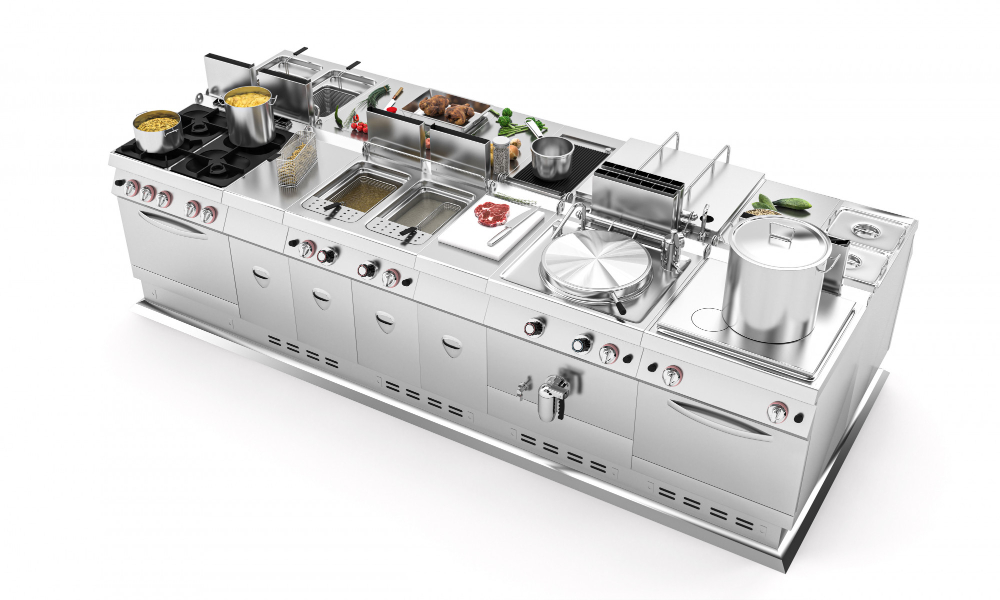
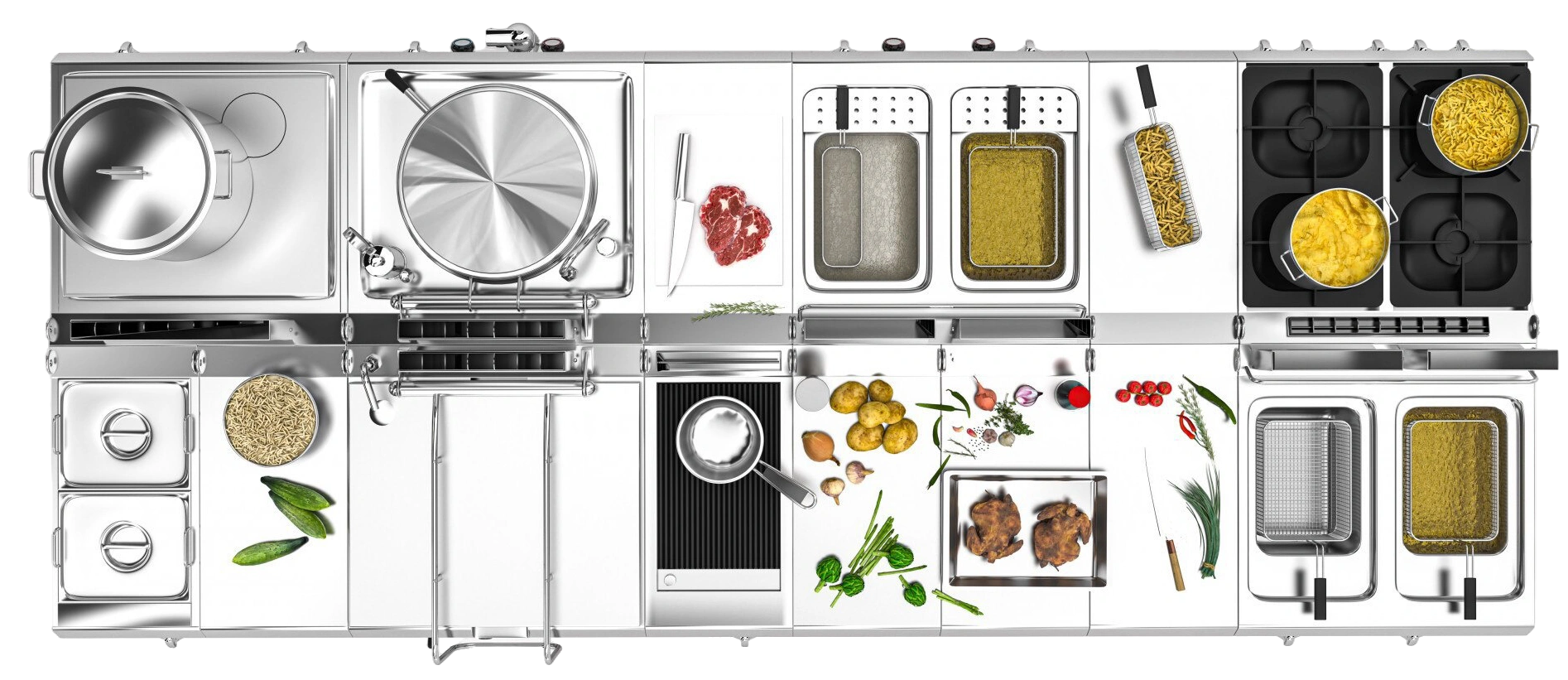
In professional kitchens, production facilities and food-service concepts, stainless steel is not just an aesthetic decision but a matter of hygiene, safety and efficiency. DE Stainless deliberately relies on AISI 304 for work lines, tables, sinks and many custom constructions – the international standard for gastronomy and food-related applications. On this page, we explain why AISI 304 is the best choice for most projects, how it compares to other stainless-steel grades, and which material strategy we recommend for your project.
AISI 304 is an austenitic chromium-nickel stainless steel with a high chromium and nickel content. This gives it:
For professional kitchens, AISI 304 is therefore the material that planners, operators and manufacturers have relied on for years.
At DE Stainless, AISI 304 is the standard material in many product lines because it offers the best balance of performance, hygiene and cost.
Surfaces made of AISI 304 are taste-neutral, do not release substances into food, and can be cleaned down to the pores. This reduces the risk of contamination and makes it easier to comply with hygiene standards.
| Property / Characteristic | AISI 316 | AISI 430 | AISI 201 |
|---|---|---|---|
| Short description | Stainless steel for highly aggressive and chloride-rich environments. | Ferritic, magnetic stainless steel for cladding and visible surfaces. | Budget-oriented alternative with reduced nickel content. |
| Corrosion resistance | Very high (molybdenum added, high resistance to chlorides). | Medium – less resistant to aggressive substances. | Medium to rather low, with higher requirements for care and environment. |
| Typical applications | Coastal regions, laboratories, industries with aggressive substances. | Fronts, claddings, furniture surfaces without direct food contact. | Economical solutions with lower mechanical and chemical stress. |
| Role at DE Stainless | Used specifically where environmental conditions require it. | Only for exterior parts and claddings that are not heavily stressed. | Only in clearly defined special cases and after coordination with the customer. |

To better classify the differences, we look at three criteria: corrosion resistance, suitability for professional kitchens, and cost-efficiency.
– Corrosion resistance: AISI 316 > AISI 304 >> AISI 201 / AISI 430
– Suitability for professional kitchens: AISI 304 ≈ AISI 316 >> AISI 201 / AISI 430
– Costs / cost-efficiency: AISI 430 / AISI 201 (cheaper) < AISI 304 < AISI 316 (most expensive option)
Our approach: For 90% of all kitchen projects, AISI 304 is the optimal choice. We use AISI 316 where environmental conditions are extreme. AISI 430 and AISI 201 are used—if at all—only for selected components without direct food contact or for clearly budget-driven projects.
Instead of “one material for everything,” at DE Stainless we follow a project-specific material mix:
– AISI 304 as the standard for work surfaces, wash areas and hygiene-critical zones
– AISI 316 for particularly exposed or chemically stressed areas
– AISI 430 / other grades for claddings, furniture surfaces or cost-sensitive exterior areas
Together with you, we analyze the installation site, load, hygiene standards and budget — and based on this, define the appropriate material strategy. The goal is a stainless-steel solution that is technically sound, durable and cost-efficient.
Are you planning a new project and unsure which stainless-steel grade is the right one? Contact our B2B team or use the inquiry form — we analyze your project and recommend the appropriate material combination of AISI 304, 316 and other grades.
Share your requirements with us – we provide personal consultation. Provide dimensions, quantity and special requests, or upload your sketches.
Our team usually responds within 24 hours (Mon–Fri) with a suitable offer.